9 min read
AI-Ready to Scale: Build the Systems Your Business Needs to Grow (Article)
Nasdaq Entrepreneurial Center October 20, 2026
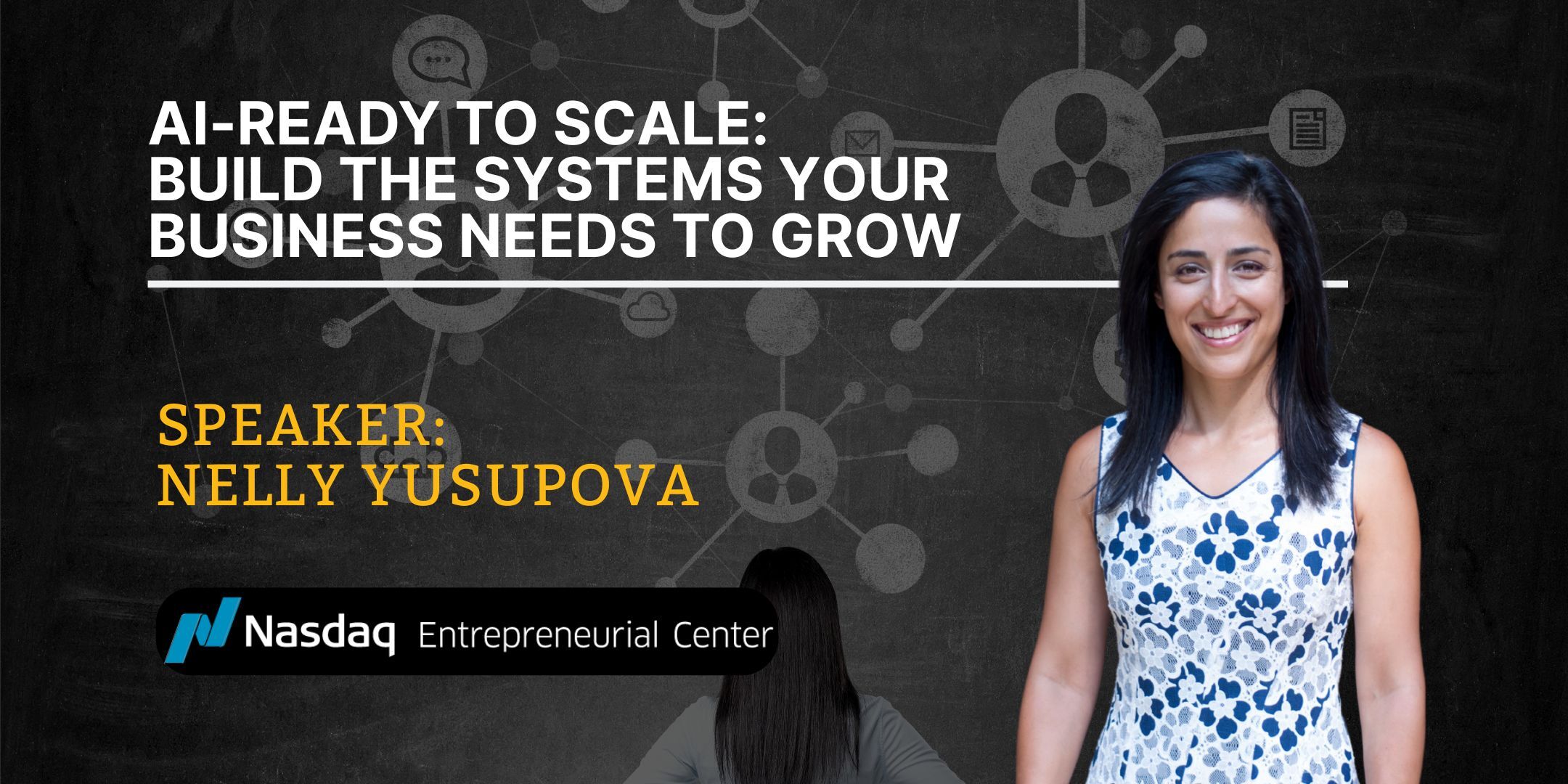
How do you make your business AI-ready to scale?
To make your business AI-ready to scale, fix your systems before you add AI. Nelly Yusupova, a fractional CTO, recommends four steps: map and clean up your processes, automate only what pays off, capture the context AI needs, and keep that context in one AI operating system every tool can use.
AI-ready to scale: build the systems your business needs first
Nelly Yusupova opens with a question for every founder who wants to grow: “If twice as many customers wanted to work with you the following month, what would happen inside your business? Would you be able to follow up, deliver the work and keep your promises?”
Without the right systems, she said, most of your day disappears into answering questions, finding information, and checking what still has to get done.
Yusupova is a fractional CTO and co-founder of TechSpeak for Entrepreneurs, and she has worked with thousands of entrepreneurs and business leaders on using technology and AI more strategically. On October 7, 2026, we hosted her class “AI-ready to scale: build the systems your business needs to grow” at the Nasdaq Entrepreneurial Center. Allison Berardi, who works with the Center’s high-growth founders, hosted. Here is what has to be in place before AI can help your business scale.
Key takeaways
- Use AI to remove whole tasks from your list, not only to finish them faster.
- Map, clean up, and standardize a process before you automate any part of it.
- Automate the steps tied to revenue or customers first, because every automation costs money to build and run.
- Give AI current, specific context about your business, or expect generic and confidently wrong output.
- Keep your context in one AI operating system that any AI tool can work from.
How do you make your business AI-ready to scale?
To make your business AI-ready to scale, fix your systems before you add AI. Nelly Yusupova, a fractional CTO, recommends four steps: map and clean up your processes, automate only what pays off, capture the context AI needs, and keep that context in one AI operating system every tool can use.
- Map each process step by step, then cut the waste.
- Automate the high-ROI steps first.
- Capture your business context, including decisions as they change.
- Store it all in one AI operating system.
AI should take work off your plate, not just speed it up
Nelly built the whole class around one conviction. “AI shouldn’t just make you faster, it should eliminate work entirely,” she said.
Doing a repetitive task faster helps. Not doing it at all frees you for the work only you can do: relationships, judgment, your lived experience. She also pointed to a second category. “I call that shelf work. It’s important work that never gets done because we don’t have the capacity.” Posting consistently on social media, following up with every contact, turning call notes into content: the work you know matters but never reaches.
The opportunity covers both piles: the small tasks you do yourself because you would never hire for them, and the shelf work that never gets done.
Climb the AI ladder one problem at a time
Nelly uses a framework she calls the AI ladder. You can move up or down it at any time. The starting point is always the same question: what problem do I have? Then pick the rung that solves it best.
Level one: tools, prompts, projects, and skills
Out-of-the-box AI tools, good prompting, projects, and skills make you and your team faster. Most businesses she meets are here. They finish tasks faster but stay “buried under the tasks that shouldn’t be yours anymore.”
Level two: automations and agents
“The real transformation happens at level two,” she said. An automation follows a workflow you have mapped in tools like Zapier or Make. “They’re much more deterministic. It’s very predictable what will happen.” Her example captures a lead, researches the company, has an AI model summarize and score it against your criteria, and drafts a reply for you to review.
An agent works differently. “With AI agents, they don’t follow the path. They decide the path in the moment with the rules that you set.” Her lead qualification agent watches a Gmail inbox, decides which leads deserve research, scores them, checks the calendar, and drafts a reply. “You didn’t map every single step in advance. You gave it a job.” You also decide when it must stop and ask you, for example approving each reply before it goes out.
Because agents are less predictable, she is cautious about using them in customer-facing work. “I find that a lot of agents are really really good in sales and marketing,” she said, since that work does not touch customer data.
The top rung: custom software
AI coding agents now let you build dashboards, internal tools, and client portals in plain language. “You don’t need to become a coder. Your role in this new system that we have right now is to describe what you need.” Nelly built a dashboard that pulls her full newsletter history from Kit so she can see what performs. One of her TechSpeak students, a non-technical financial planner, connected a landing page, Stripe, a survey tool, and an AI-generated report into a lower-cost product for earlier-stage clients. “Now she can serve more people at scale and she doesn’t have to be directly involved in every transaction.”
You can’t automate chaos
“The reality is you can’t automate chaos,” Nelly said. When the sales process lives in someone’s head and the onboarding checklist is a forgotten document from years ago, automation only makes things worse. “It’s like pouring gasoline on a fire. You’re just going to get a bigger mess a lot faster.”
Before automating, she said, do the groundwork:
- Define the process in detail, including how decisions get made.
- Eliminate inefficiencies, such as the wrong tools or missing data.
- Standardize so the work is repeatable and predictable.
She captures this in what she calls a workflow planning map: a bird’s-eye view of every step, decision point, and handoff, including where a human reviews the work.
Then decide what to automate. “Just because something could be automated doesn’t mean that it should be.” Go after the high-ROI processes tied to revenue and customers first, because “all of these automations cost money. They’re not free.” If a manual step is cheap and not critical, leave it manual.
Context is king when it comes to AI
“Every rung on the AI ladder runs on context,” Nelly said. Prompts, projects, automations, agents, and software all depend on what you give them, because “AI is not magic.”
She described what happens when context is missing. “If the context is thin, the output will be generic. If the context is outdated, the output will be confidently wrong.” Scattered context produces inconsistent results, and with no context at all, AI fills in the gaps itself. If you do not trust your agents, she said, the likely cause is missing or outdated context.
She separates two kinds. Starting context is what is already true: who you serve, what you sell, how you sound, your process documents. But “the more valuable context is the one that changes while you work”: the decisions, corrections, and new rules you make every day. “Unless that change gets captured into a system, AI will keep working from the version of your work that stopped being true.”
Most founders never capture it. Decisions happen on unrecorded calls, fixes stay inside one chat, rules live in Slack. As a result, she said, “you become the person carrying the information between them.”
Build one AI operating system that every tool can use
Her answer is an AI operating system. “It is one place where your context, your instructions, your examples, decisions, and workflows live.” It is a set of files, folders, instructions, workflows, and code, with an index that works like a librarian, so AI can find the right context without reading everything.
The payoff is that your context is separate from any single tool. Models change constantly, so you can point whichever tool works best for each job at the same system. “You just have to point the right tools with the right brain at the same foundation.” You could even switch to an open-source model running on your own machine later without moving your system.
Her example: a client needed more than 400 book images cleaned and turned into square thumbnails. She spent about an hour building and refining an image-cleaning skill, stored it in her operating system, and layered a workflow on top: open the spreadsheet, find each image, clean it, rename it, upload it, add the link, and check the title. She then ran two agents on the same spreadsheet, one from the top and one from the bottom. When Claude found a faster way to batch the work, she had it update the system, and Codex followed the improved process too. “So one agent found a better way to do the work. I told the system to capture it and another agent could use it. That’s how your AI work compounds.”
For this to work, she said, the way you work has to change. “You have to start working in public. Don’t freak out. I don’t mean like go public to the internet. I mean public to your system.” Treat your knowledge and context as an asset that keeps paying off. And you do not have to build it all at once. “Think of it as a Lego that you’re building. It doesn’t have to be the castle from day one.”
Pick one process to make AI-ready this week
Nelly closed with a question: what is one thing in your business that would make a meaningful difference if you automated it, improved it, or handed it to an agent? Write it down. Then name what has to be true first: a clarified process, gathered information, defined rules, or a decision about what you will review.
Scaling with AI goes better alongside founders working through the same questions. Milestone Makers alumni have raised $1B+, and the program has served 400+ founders. It is a free, competitive 12-week cohort for high-growth founders working on fundraising, scaling, and hiring. To keep learning, browse the Center’s free Community Classes, live every week.

Nelly Yusupova
Fractional CTO, Startup Tech Advisor
Creator of TechSpeak
Nelly helps founders and businesses cut costs, find product-market fit faster, and scale with AI. With more than 20 years of experience leading companies to technical excellence, she is a highly sought-after fractional CTO/CPO, startup tech advisor, AI strategist, and educator.
She is the creator of TechSpeak for Entrepreneurs, a self-paced bootcamp and expert-guided 12-week tech accelerator for nontechnical startup founders. She also created Build the AI Operating System Your Work Runs On, a 6-week live training that helps nontechnical professionals use AI to streamline operations, improve decision-making, and build more leverage into their work.
In addition, Nelly is a mentor for Techstars, Founder Institute, StartOut, WEVE Acceleration, and DigitalUndivided, and more. She has been included on many lists of transformative women in tech, including Fast Company’s “League of Extraordinary Women'' and Wall Street Journal’s “Women on the IT Fast Track.” Nelly has been at the forefront of the women’s movement online since 1997.
Nelly is a speaker and presenter for many organizations and major industries events including: HBS Women’s Association, Columbia University, Sloss.Tech, Women’s Enterprise Center, Founder Institute, Saas Academy, Black is Tech, Roadmap For Billions, GSV Bootcamp, WeWork Labs, TechDay, Unvalley, FastTrac NewVentures, Womens’ Venture Summit, Small Business Summit and has been featured in INC Magazine, NBC Today Show, Fast Company Magazine, NewsDay.com, O’Reilly, SmartMoney, SmallBiz, TechRepublic, Women’s Radio.
FAQ's about building AI-ready systems
The Nasdaq Entrepreneurial Center hosts free live classes led by experts every week, and many are available on demand. Browse upcoming and past sessions on the Center’s Community Classes page. Its programs, workbooks, and mentorship are free for founders everywhere.
The Nasdaq Entrepreneurial Center (the Center) is an independent nonprofit building a better path for entrepreneurs worldwide. Established in 2014 with the support of the Nasdaq Foundation, the Center delivers free education to meet the real-time needs of founders. Learn more at nasdaqcenter.org.
%20(Landscape))%20(14)-1.png?width=2000&height=1000&name=partner%20logo%20%20(Medium%20Banner%20(US)%20(Landscape))%20(14)-1.png)
The Nasdaq Entrepreneurial Center is a 501c(3) public charity whose mission it is to make entrepreneurship accessible to all. We deliver free resources, expert guidance, and top-tier mentorship to over 100,000 entrepreneurs worldwide. Your support helps us continue delivering these transformative programs—expanding access to entrepreneurship and driving economic progress for all. Join us and make a gift today to help more entrepreneurs thrive!
All Nasdaq Entrepreneurial Center programs and services are extended to the public on a nondiscriminatory basis. Reasonable accommodations for persons with disabilities will be made if requested at least 48 hours in advance of this event; please send an email to nasdaqcenterlive@nasdaqcenter.org with the subject header ACCOMMODATION REQUEST. For assistance with registration or other technical difficulties, please contact hello@nasdaqcenter.org.
If you haven't already, please add hello@nasdaqcenter.org to your safe senders list.