8 min read
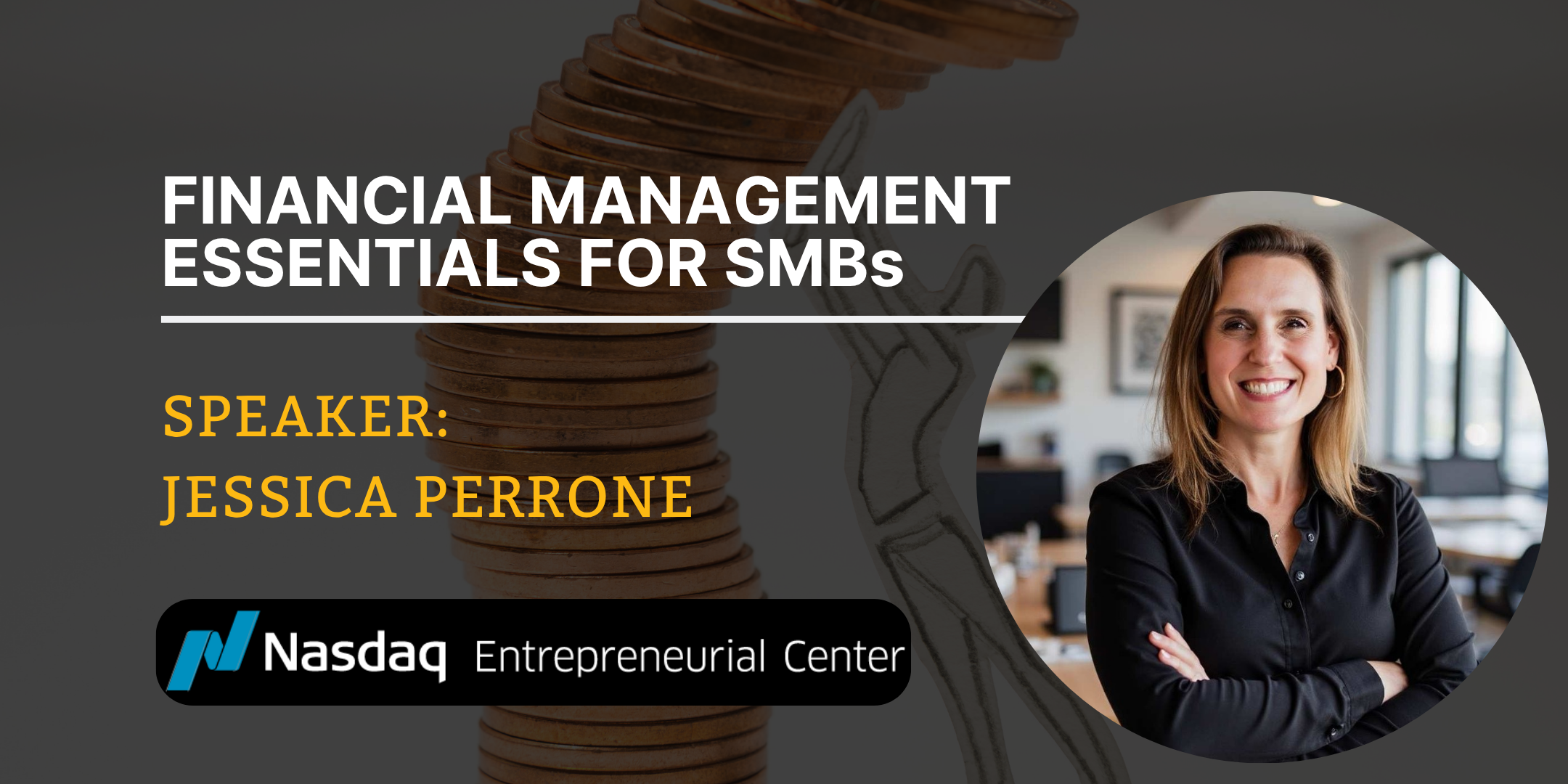
Financial Management Essentials for SMBs (Article)
Nasdaq Entrepreneurial Center October 20, 2026
How should a small business owner set up their finances?
Set up your small business finances by separating them from your personal money first. Jessica Perrone, founder of Her Financial IQ, recommends five steps: form an LLC, open separate business bank accounts, connect them to bookkeeping software, price your own time, and set a firm limit on what you will invest.
- Form an LLC for each business, using a registered agent.
- Open separate business checking and credit card accounts.
- Connect business accounts only to one bookkeeping file per company.
- Calculate your hourly value and outsource below it.
- Draw a line in the sand on personal investment.
Financial management essentials for SMBs: get your money in order
Jessica Perrone’s first business ran on Venmo requests. She had a name, a product, and paying students for her online courses, but no business bank account and no system for tracking what came in or went out. “I really didn’t have the background to stay organized and really think about expanding,” she said.
If your business finances still live in your personal checking account, you are where she started. Perrone is the founder of Her Financial IQ and founder and CEO of the Hey Jessica AI financial coach, and a spring 2026 graduate of the Center’s Milestone Circles program. On October 8, 2026, we hosted her class “Financial management essentials for SMBs” at the Nasdaq Entrepreneurial Center, with Allison Berardi as host. She was clear that she is not a CPA or a lawyer. What follows is the practical setup she would share with you over coffee.
Key takeaways
- Form an LLC for each business so one company’s problems cannot reach your personal assets or your other businesses.
- Keep personal and business bank accounts and credit cards completely separate, with one set per LLC.
- Connect only your business accounts to one bookkeeping file per company to see your real cash burn.
- Calculate your hourly value, then outsource tasks that cost you more time than they are worth.
- Set a line in the sand: the most personal money you will put into the business.
How should a small business owner set up their finances?
Set up your small business finances by separating them from your personal money first. Jessica Perrone, founder of Her Financial IQ, recommends five steps: form an LLC, open separate business bank accounts, connect them to bookkeeping software, price your own time, and set a firm limit on what you will invest.
- Form an LLC for each business, using a registered agent.
- Open separate business checking and credit card accounts.
- Connect business accounts only to one bookkeeping file per company.
- Calculate your hourly value and outsource below it.
- Draw a line in the sand on personal investment.
Start with a simple LLC and a registered agent
Perrone calls these steps her founder ducks, and the first one is your entity. Her advice is to pick a simple setup and move. “Paralysis by analysis. Anyone ever heard of that?” she asked. She formed a New Jersey LLC rather than researching every option, and she noted that founders planning to raise outside funding often hear about Delaware C corporations, which she is exploring next.
The reason to form an LLC at all is protection. “An LLC defends yourself personally from the company,” she said. “It is your first line of defense personally on day zero.” She also keeps a separate LLC for each business, so that if something goes wrong in one, the others are shielded.
She used a registered agent, a service that files your LLC paperwork and can serve as your official business address. That kept her home address off public records, and she added a PO box for mail. “You really do not want mail coming to your own house, especially if you are virtual,” she said. The agent also obtained her EIN, the tax ID number the IRS assigns to a business. Those two documents are what you take to the bank.
Her standard for this stage: “It doesn’t have to be perfect. It just got to get done because time is money.”
Keep personal and business money completely separate
“We really want to make sure that our personal accounts and our business accounts are completely separate,” Perrone said. “And the reason being is transparency.” When you pay for groceries with the business debit card or fund the business from personal checking, you cannot see what the company actually costs, earns, or is owed.
Perrone runs three LLCs, and each has its own business checking account and credit card. “Yes, I’m carrying around multiple credit cards, but it really in the end makes life so much easier to have the separate bank accounts and credit card accounts.”
Add a bridge loan fund for yourself
Her third account is one most founders have never heard of. She calls it a bridge loan fund: personal savings she sets aside to invest in her own companies, kept in a high-yield savings account so it earns interest while it waits. When a business needs cash, she lends it money from this fund and tracks it as an investment to be paid back.
“This is just me being an angel investor into my own account,” she said. An angel investor is someone who puts personal money into an early-stage company. She does not do it for tax reasons. “I do it for peace of mind and operating.” The fund also shows her, at a glance, how much she has put in and how much is left.
When an attendee asked whether you can set your own payback terms, Perrone said yes, and that she does. With Her Financial IQ, she paid herself back everything she had put into the business.
Use bookkeeping software to see your real cash burn
Once your accounts are separate, connect them to bookkeeping software. Perrone set up a QuickBooks Solopreneur account for each LLC and connected only the business checking account and business credit card. Her rule: “You do one QuickBook per EIN. No exceptions.”
The payoff was visibility. For the first time, she could see her cash burn, the amount of money the business spends each month, and the day her dashboard first showed her business as profitable is one she still remembers. The software also handles invoices and automatic collections, and it connects to payment tools such as PayPal, Square, and Stripe so orders that come in overnight show up in your books.
The setup is where she stumbled. She spent about a week on online tutorials, a week she could have spent on paid workshops and business development. “Yes, it was the best thing I did, but it was the dumbest thing I ever did trying to set it up myself.”
Price your time before you decide what to outsource
That lost week led to her next founder duck. “Your time is your most valuable asset,” Perrone said. Work out what an hour of your time is worth, then use that number to decide whether to do a task yourself or pay someone else.
To set her own hourly value, she uses what she earns for an hour of a workshop or program. If she is doing a task that pays less, she is losing that income. She also urged founders not to undervalue themselves: “So often individuals don’t take into account all their wisdom,” along with their contacts and years of experience.
For her bookkeeping, she hired a contractor through Upwork, who set up the software and walked her through how it worked. Perrone stressed that last part. “It’s actually very important for you to understand how QuickBooks works so that you can check initially your bookkeeper’s work.” She later hired an ongoing bookkeeper the same way, and she uses contract labor whenever she needs a specialist for a project rather than a full-time hire.
Draw a line in the sand before you invest more
Her final founder duck is a firm limit on how much personal money you will put into the business. “Think of it as going to Vegas with your kitty that you are willing to lose,” she said. “I can win, I can lose, but I’m not spending any more money than this.”
For Perrone, the bridge loan fund is that line. When it runs low, she shifts her time toward sales and business development. She has had to draw on it recently to fund faster development of the Hey Jessica app, and she has a plan to refill it when contracts restart.
The math for quitting your day job
She went all in on her business on December 1, 2025, after building her savings through contract work. Her three tests before making that leap:
- Proof of concept: “Business covers 100% of its operating costs. That’s number one.”
- A buffer: three to six months of operating expenses saved, like an emergency fund for the business.
- Income replacement: consistent profits that cover your personal spending plan.
Set up one founder duck this week
Pick the duck you are missing and handle it before Friday. If your business money and personal money still share an account, open a separate business checking account and credit card first. Everything else, from bookkeeping to your line in the sand, depends on that separation.
You do not have to sort out cash flow and growth alone. Perrone credited the Center’s Milestone Circles program, presented by the Wells Fargo Foundation, with giving her the confidence to build her latest company. It is a free, 12-week, peer-led virtual program for U.S.-based founders working on growth, and it has served 8,876 founders. For more practical sessions, browse the Center’s free Community Classes.
Watch the full class recording.

Jessica Perrone
Founder
Jessica Perrone is a former Wall Street professional, Accredited Financial Counselor® (AFC®), NASDAQ Entrepreneurial Center Milestone Graduate, and founder dedicated to making financial education practical and accessible. She is the founder of HerFinIQ, which empowers women to become confident Wealth-Creators, and creator of the Hey Jessica Financial Coach App. Expanding her mission into corporate wellness, Perrone also founded FinIQ Edu, a co-ed workplace education segment that delivers actionable financial literacy to teams and founders. Through national media appearances, keynote speaking, and community initiatives, Perrone demystifies money management and equips individuals with the systems and confidence needed to take control of their financial futures.
FAQs about small business financial management
The Nasdaq Entrepreneurial Center (the Center) is an independent nonprofit building a better path for entrepreneurs worldwide. Established in 2014 with the support of the Nasdaq Foundation, the Center delivers free education to meet the real-time needs of founders. Learn more at nasdaqcenter.org.
%20(Landscape))%20(14)-1.png?width=2000&height=1000&name=partner%20logo%20%20(Medium%20Banner%20(US)%20(Landscape))%20(14)-1.png)
The Nasdaq Entrepreneurial Center is a 501c(3) public charity whose mission it is to make entrepreneurship accessible to all. We deliver free resources, expert guidance, and top-tier mentorship to over 100,000 entrepreneurs worldwide. Your support helps us continue delivering these transformative programs—expanding access to entrepreneurship and driving economic progress for all. Join us and make a gift today to help more entrepreneurs thrive!
All Nasdaq Entrepreneurial Center programs and services are extended to the public on a nondiscriminatory basis. Reasonable accommodations for persons with disabilities will be made if requested at least 48 hours in advance of this event; please send an email to nasdaqcenterlive@nasdaqcenter.org with the subject header ACCOMMODATION REQUEST. For assistance with registration or other technical difficulties, please contact hello@nasdaqcenter.org.
If you haven't already, please add hello@nasdaqcenter.org to your safe senders list.