8 min read
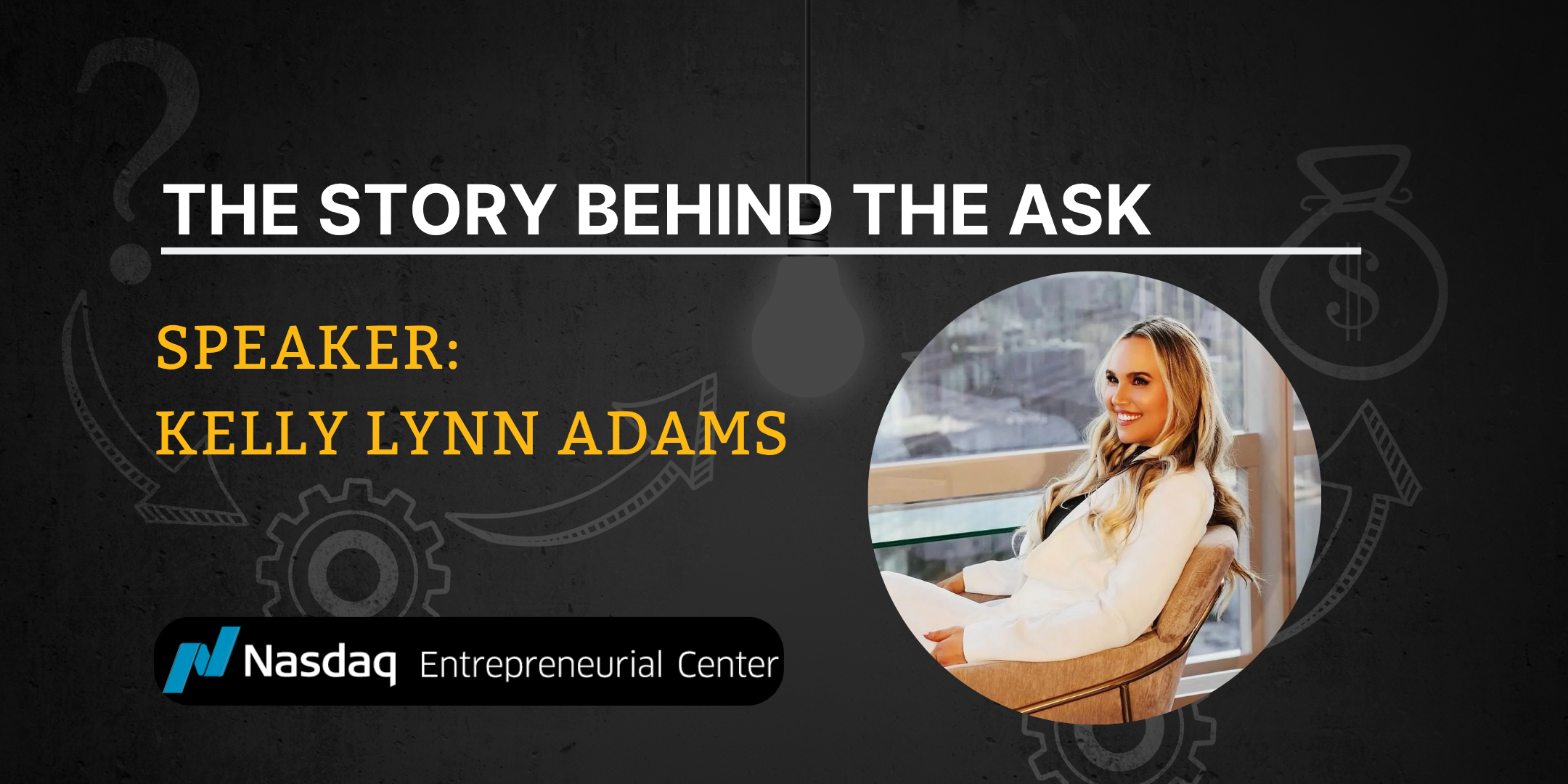
Kelly Lynn Adams pitched a publication she badly wanted to write for and never heard back. So she found out that one of its decision makers would be at an event in New York City, went, and waited in line to make her ask in person. She was nervous, underprepared, and still working a corporate job. The decision maker handed her a card and said, “Contact my team, tell them you spoke to me, and send us your pitch.” Weeks later, she was a contributor.
Adams is a mentor, certified executive coach, business strategy consultant, and thought leader. On October 13, 2026, we hosted her class “The story behind the ask” at the Nasdaq Entrepreneurial Center, with Allison Berardi, program coordinator for high growth impact entrepreneurs at the Center, as host. Whether you are asking for investment, a partnership, a client, or a community, here is the framework she uses.
Key takeaways
- Make the ask, even if you are not fully ready, because many founders never ask at all.
- Answer why you, why now, and why this before you say what you need.
- Keep a running list of your wins so you always have proof to draw from.
- Change your story for investors, customers, partners, and community members.
- Treat each no as a story you can use in your next ask.
Start by making the ask
If you remember one thing, Adams said, remember this: “Make the ask. Because a lot of people don’t ask.” In her view, simply asking is about half the win.
A no is not the end, either. Adams once served a potential client before they ever hired her. Before that client signed, they sent her a referral. “You never know where the yes is going to be coming from,” she said. “And the no is just a redirection in the right direction.”
The framework below helps you ask well. But it starts with asking.
Context: give your ask meaning before you make it
Before you ask, answer the questions your audience is already thinking. Adams boils them down to three: why you, why now, and why this. Then add a fourth: what’s in it for them?
Your answer should show what problem you solve or what you make better. Will it save the other person time or money? Make their life or business easier? For investors, she said, the question is simple: what’s the return on investment?
Context changes with the audience. A sentence that works in a room full of people in your industry may need plain language for a general crowd. If you use an abbreviation for your profession or product, spell it out the first time.
Credibility: balance emotion with evidence
“Stories sell, facts tell,” Adams said. A strong ask combines human connection with proof, such as traction, results, or expertise.
If you think you have no proof yet, think again. “All of you have successes. Every single one of you.” When she made her first ask, her business was new. So she leaned on her corporate career, the companies and leaders she had worked with, and her ability to manage a full-time job while starting a business.
Her advice is to keep a win list: a running list of accomplishments from any part of your life. Pull from it whenever you need proof, and read it every day to build your confidence. Even a success that is not directly related to your ask can show resilience, determination, and persistence, which is often what investors and clients want to see.
Put your strongest proof point first. When one founder in the class shared that her product was already sold by a national retailer, Adams said that was the credibility to lead with, and the way in to the next opportunity.
Connection: adapt your story to your audience
The same founder needs a different story for each audience. Adams breaks it into four groups:
- Investors: they want to know what’s in it for them, starting with the return. You may be asking for capital, for equity, or simply for attention.
- Customers: they want to know what problem you solve and how you make their life easier, faster, or better. Your story becomes proof of concept.
- Partners: you both have limited time and energy, so show the benefit to each of you. “Partnership is all about collaboration,” she said.
- Believers, such as co-founders and community members: they want a vision and a mission worth following. A personal story about why you started carries the most weight here.
Call to action: land the ask with conviction
Once the context, credibility, and connection are in place, state what you need. “The most important thing here is the energy behind the ask,” Adams said. That means conviction, not a hard sell.
Read the room and put yourself in the other person’s shoes. Would they want a pitch, or a conversation? Be specific, and do not over-explain. She offered a simple template: “What I’m asking for is this so that I can get this.” If your delivery is a little off, you will learn from it. As she put it, “the call to action will be strong if your story is strong.”
The same goes for data. Many listeners want the bottom line first. Adams recommends sharing high-level numbers and letting the other person ask for more. “Always start with less. Less is more.”
What to do after a no
A no often means not right now. Adams recommends asking directly: Would you like me to follow up? Would you be interested in six months or a year? Then get curious about what the other person needs now.
Pace depends on the industry. Some move fast, and many people are simply buried in email, especially at the end of the year. Some people appreciate the follow-up. Others do not. Read the situation, and research the industry if you do not know its pace.
You can also help anyway. If you connect someone to an investor or partner they need, “guess who they’re going to think of,” she said.
Over time, your setbacks become material. “You want to collect the nos, collect the hard moments,” Adams said. “You’re just going to have a story bank for days and you can build any story behind any ask.”
Try it: write your context sentence
In the live workshop, Adams and Berardi asked attendees to write one sentence describing what they do and why it matters. Their feedback on those sentences gives you a quick checklist:
- Say who you serve and what changes for them, such as more confidence, saved time, or higher revenue.
- Spell out any abbreviation for your profession or product the first time you use it.
- Use a specific example instead of an abstract promise.
- Add one proof point that backs up the claim.
- Rewrite the sentence for each audience you plan to ask.
Make one ask this week
Before your next ask, Adams’ advice is two words: “Get intentional.” Answer why you, why this, why now, and why them, and remember that you also get to choose who you ask. “You get to decide if you want that client.”
Then make the ask. If you are a high-growth founder preparing for investor conversations, Milestone Makers alumni have raised $1B+, and the program has served 400+ founders. It is a free, competitive 12-week cohort for high-growth founders working on fundraising, scaling, and hiring. For more free sessions, browse the Center’s Community Classes.
Watch the full class recording.

%20(Landscape))%20(14)-1.png?width=2000&height=1000&name=partner%20logo%20%20(Medium%20Banner%20(US)%20(Landscape))%20(14)-1.png)